The Science Behind Our Solution
Human Factors Science
The effectiveness of visual clarity is driven by an optimized combination of flash rate, light volume, color and intensity.
Virginia Tech Evaluation of
High-Frequency Hazard Lighting Efficacy
The Virginia Tech Transportation Institute (VTTI) is a global leader in transportation safety research, applying rigorous scientific methods to evaluate and improve real-world safety systems. VTTI partners with automakers, suppliers, and policymakers to quantify performance benefits, resilience, and unintended consequences of emerging technologies.
VTTI Phase 1 Study (2021): Defining the Optimal Flash Rate -- VTTI evaluated dozens of highly conspicuous lighting patterns to identify the most effective hazard-light flash characteristics.
Key Finding:
- 4–6 Hz flash frequencies are significantly more attention-grabbing and convey a stronger sense of urgency than standard hazard flashers
- This range represents the optimal balance between urgency and driver comfort — maximizing noticeability without excessive glare or annoyance
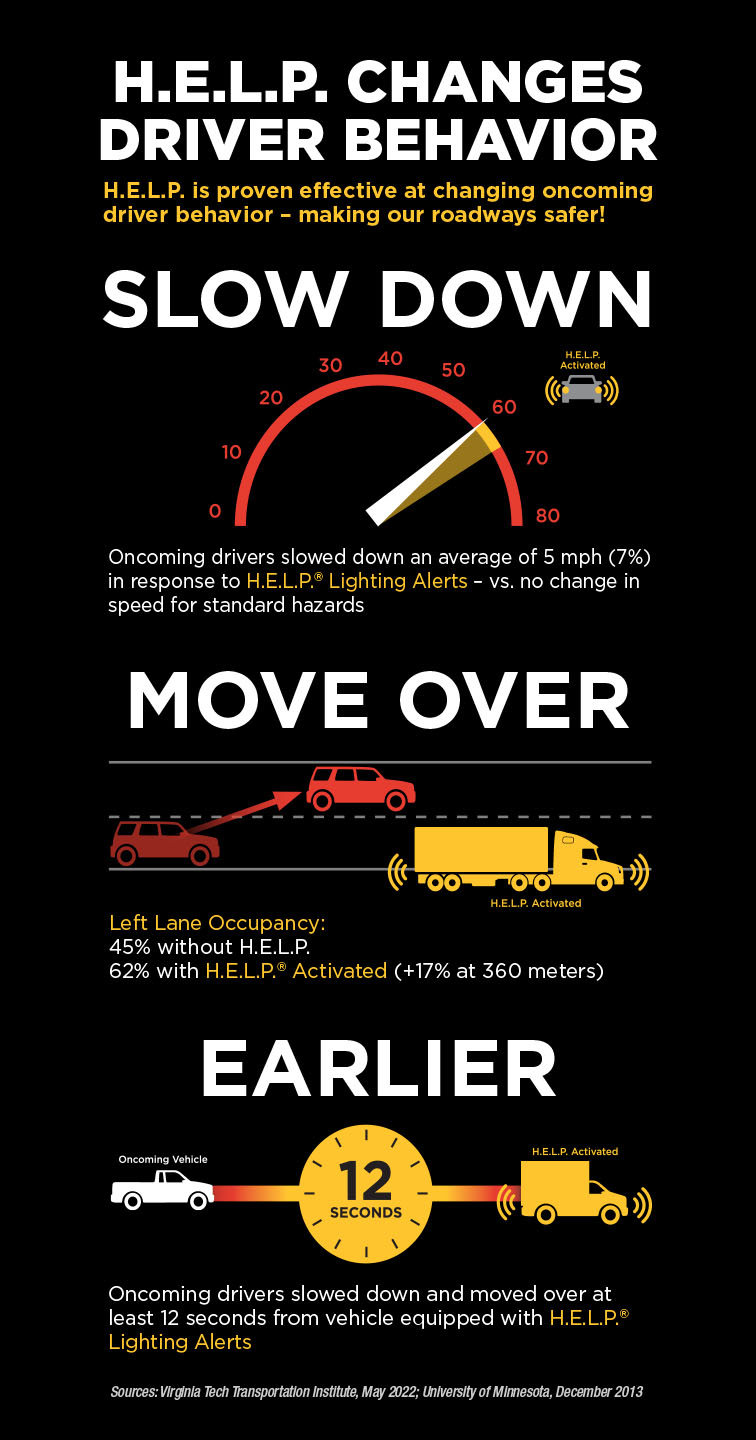
VTTI Phase 2 On-Road Study (Spring 2022): Real-World Driver Response -- VTTI then measured oncoming driver behavior when approaching a disabled vehicle using H.E.L.P.® Lighting Alerts (5 Hz) versus standard hazard lights.
Documented Driver Responses to H.E.L.P.® Alerts:
- Drivers Slow Down Earlier -- Drivers decelerated sooner and at significantly greater distances compared to standard hazards.
- Drivers Move Over More Often -- Drivers frequently changed lanes — often a full lane away — at distances of up to 360 meters (nearly four football fields).
- Drivers Gain Critical Reaction Time -- Most drivers slowed and moved over before reaching the farthest observation point, providing 12+ seconds of advance warning.
Within Visual Range: Proven Human Factors Science
Decades of empirical human-factors research confirm that higher emergency light flash rates improve driver perception and urgency recognition. VTTI studies demonstrate that increased flash frequency significantly enhances urgency without crossing thresholds of discomfort or annoyance — findings reinforced by research from NASA’s Ames Research Center.
The graph displays flash frequency against three dimensions of visual clarity – discomfort glare, annoyance and urgency. This finding is reinforced by studies conducted by NASA’s Ames Research Center.

Beyond Line of Sight: Digital Alerts That Extend Protection
H.E.L.P.® goes beyond visibility.
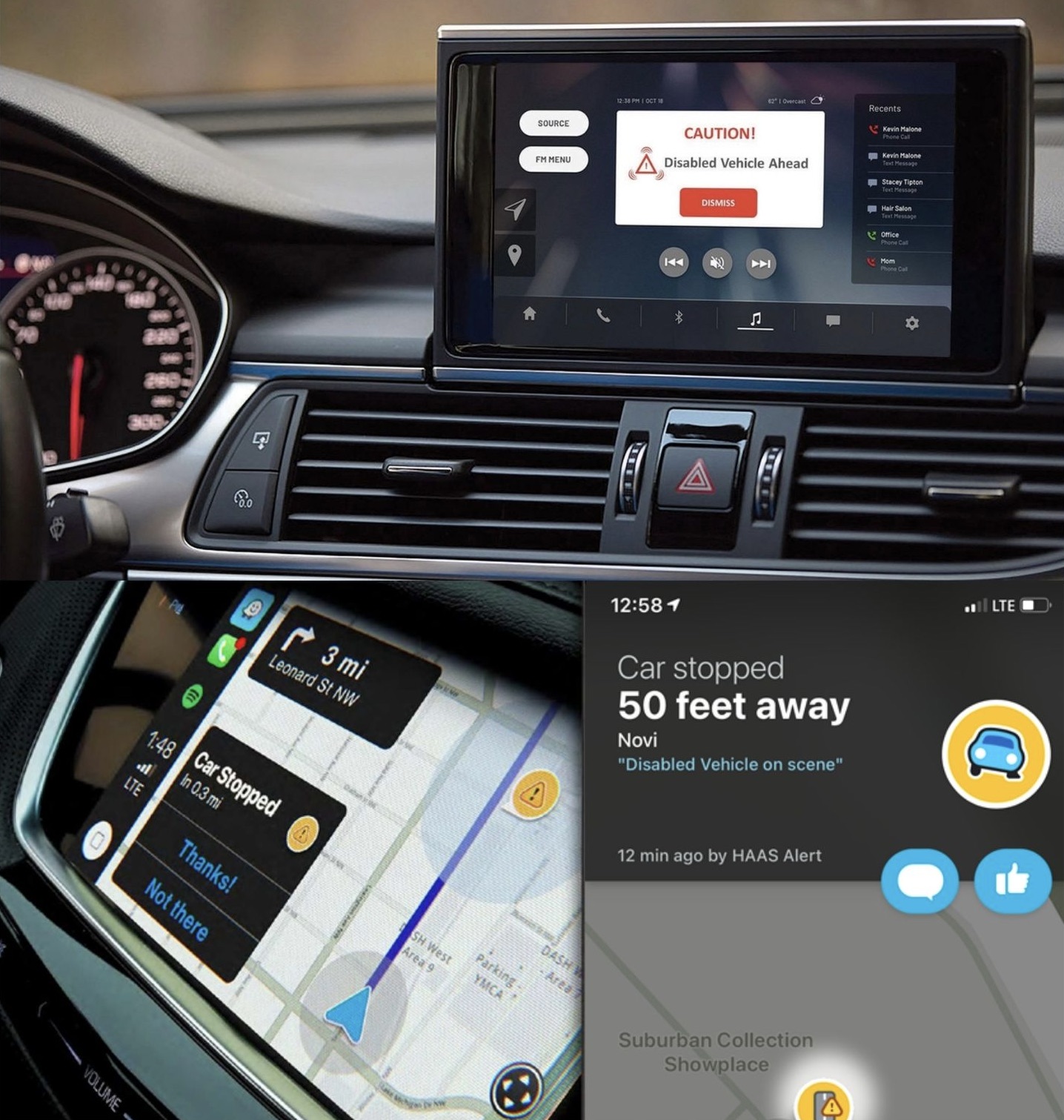
When activated, H.E.L.P.® Lighting Alerts automatically generate a digital hazard signal that is detected by emergency information systems and consumer navigation apps — alerting drivers before the vehicle is visible.
This combined visual and digital alerting provides earlier awareness, safer maneuvering, and dramatically improved protection for motorists and roadside occupants — helping prevent secondary crashes and save lives.
.png)